hold.that.thought. Blog
How to Plan a Custom Trophy Program: Design to Delivery
By Hollywood 3D Printing ·
Key Takeaways
- Decide concept, finish, first-article approval, personalization, quantity and delivery before you fix a production date.
- A first-article prototype takes 2–4 weeks and standard trophy production takes 3–6 weeks, with gold or chrome plating adding about two weeks.
- Runs over 100 units get mid-production samples, and there is no minimum quantity.
- Engraving, nameplates, serial numbers and individual names can be added to the same sculpture, so plan the recipient list early.
- We can extend or match an existing trophy series from samples, photos or old files, and ship to many recipient addresses.
To order custom trophies for an awards show or corporate program, settle six things in order: the concept, the finish, a first-article approval, the personalization method, the quantity plan and the delivery plan. Then count backward from the ceremony. A prototype takes 2–4 weeks and standard production 3–6 weeks depending on quantity and finish, and gold or chrome plating adds about two weeks. Start early enough that an approval round does not eat your production time.
This is a planning checklist. For the broader picture of what we make and how, read our guide to custom trophies and awards in Los Angeles and the custom trophies industry page.
What should you decide first: concept and audience?
Before anyone talks about finish or schedule, write down three things: who receives the trophy, where it will be presented, and what it should say about your brand or event. A broadcast award that will be held up on camera needs different treatment from a hundred employee-recognition trophies mailed to home offices, even if the artwork is similar.
- The design concept. A figure, an object tied to your brand, a scaled-up logo, or an abstract form. Send sketches, reference images or an existing file; if you have none, we do the 3D design from a sketch with dimensions and references (see 3D design).
- Size and weight. Recipients carry these onto stages and through airports.
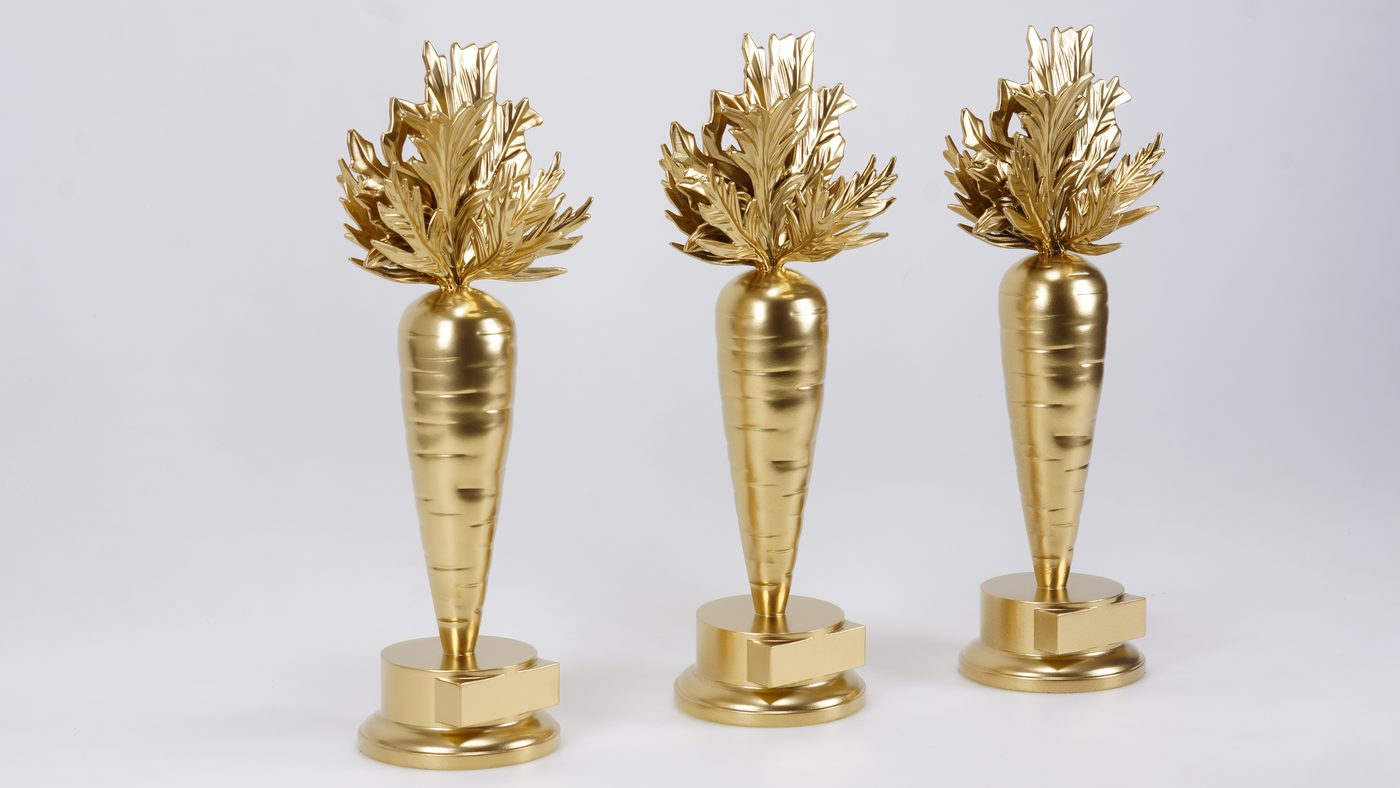
- How many tiers of award. Many programs use the same form in different finishes, for example gold for the top prize and silver or bronze for other placings.
- Who approves. Name the approver early; a slow approval eats directly into your production window.
Which finish should you choose: gold plating, chrome, painted or patina?
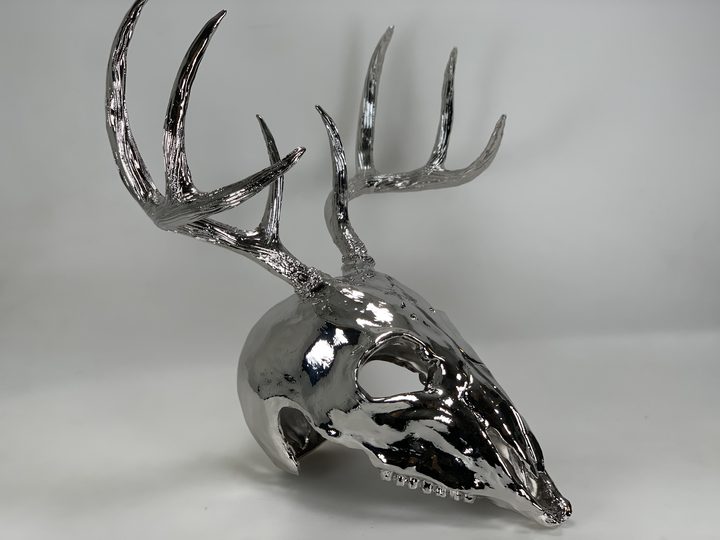
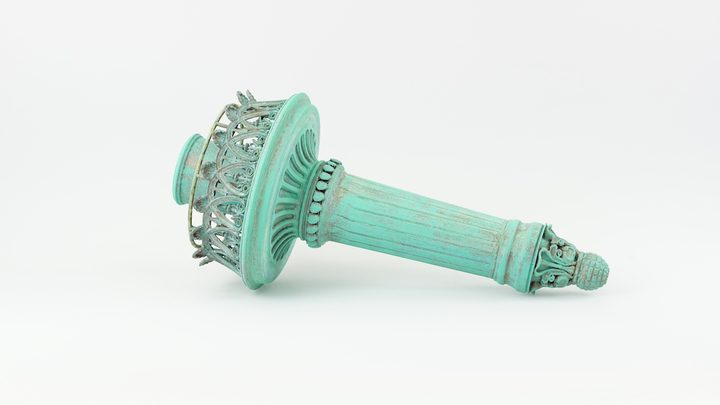
Finish drives both the look and the schedule more than almost any other decision. We offer four for trophies: gold plated, chrome plated, painted or Pantone-matched, and patina. Here is how they compare:
| Finish | What you get | Time added |
|---|---|---|
| Gold electroplating | Real gold over a copper base on SLA resin, mirror or satin | About 2 weeks |
| Chrome electroplating | Real rhodium over a copper base, mirror or satin | About 2 weeks |
| Metallic gold or silver paint | Convincing metallic look, faster than plating | 2–3 days |
| Single-color Pantone spray | Exact brand color match | 2–3 days |
| Detailed hand painting | Multi-color figures and fine detail | Up to 1 week |
| Patina, verdigris, aging | Aged bronze, copper or weathered looks | Quoted with the project |
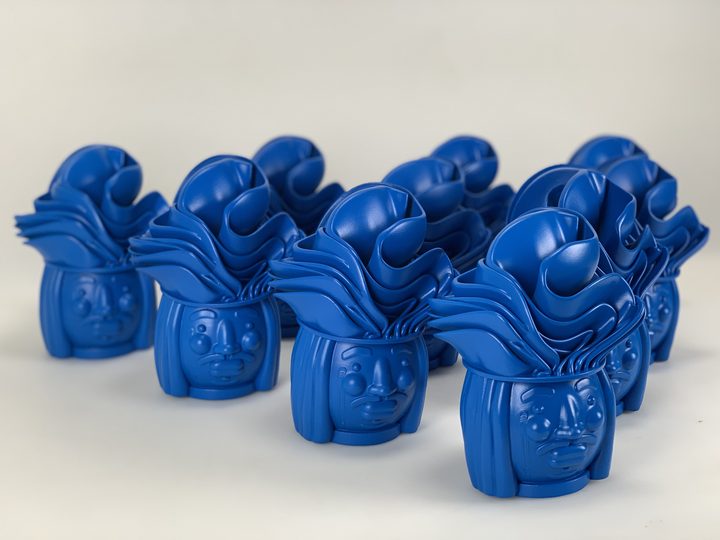
Plated finishes read as real metal on camera, which matters for televised or filmed ceremonies. Painted and Pantone-matched finishes are the right choice when color, not metal, is the point. The details of the process are in our guides to chrome and gold plating and painting and Pantone matching. We focus on commercial and production projects, and there is no minimum quantity.
Why approve a first article before production?
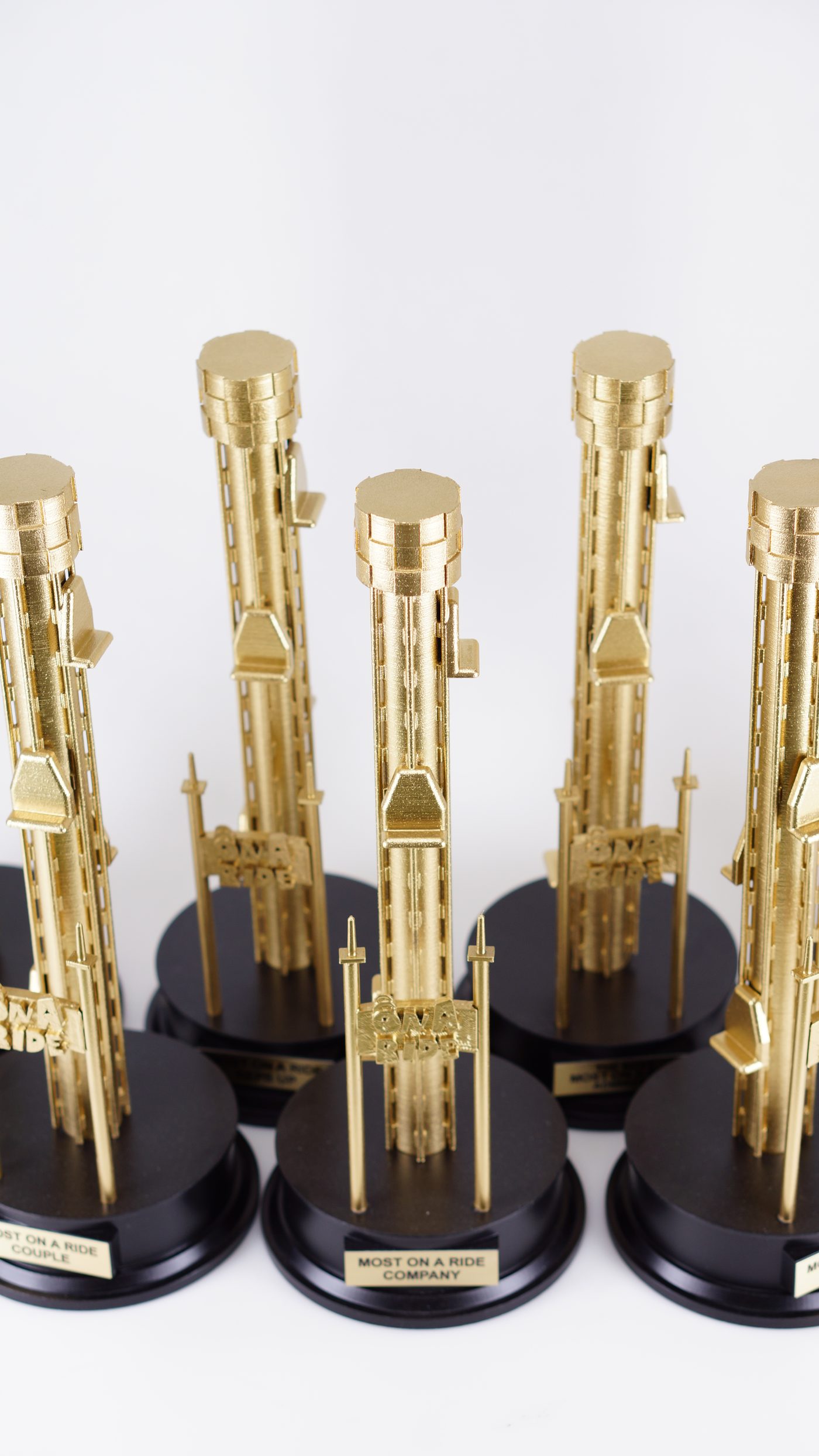
A first article, or prototype, is a finished sample made to production standard before the run is committed. It takes 2–4 weeks. It is the moment to check proportions, weight, finish, nameplate placement and how the piece feels in the hand, while changes are still easy to make.
Our normal process starts with a design consultation, then a 3D model and full-color renderings for approval, with renderings and finish samples typically within 3–5 business days. Only then do we build the first article. For a large run, the first article also becomes the reference the rest of the pieces are compared against. On runs over 100 units, we send mid-production samples so you can see progress before the whole batch is finished.
How does personalization work at scale?
Personalization is where a trophy program can quietly become complicated. Decide how each piece will be individualized before production starts, because it determines what can be finished in bulk and what has to be done piece by piece.
- Engraving and nameplates. Plates on the base carry the recipient, award category or year. The sculpture can be identical for everyone.
- Serial numbers. Useful for limited-edition or multi-year programs, and for tracking pieces.
- Individual names. Send the list as a clean spreadsheet with exact spellings, titles and category text, and have someone on your side proof it. Names are hard to fix once they are engraved.
- Variable text. If the wording changes by recipient, keep a version-controlled master list and tell us which fields may change.
A practical trick is to separate the sculpture from the personalization. If the final winners are not known until the ceremony, the finished sculptures can be produced and the plates added at the end. Tell us your deadlines for final names and we will plan around them.
How do you plan quantity, especially for 100 or more?
There is no minimum quantity, so a single trophy is a legitimate order, and our largest single order was 11,500 units. What changes with volume is the plan, not the eligibility.
- Add spares. Ask for a few extra pieces beyond the count of recipients. A last-minute winner, a damaged piece in transit or a replacement is easier with stock on hand.
- Expect mid-production samples over 100 units. Review and approve them promptly; production schedules assume timely replies.
- Standard production is 3–6 weeks. The range depends on quantity and finish.
- Consider silicone casting for larger runs. Some multiples are more efficient as casts than prints; see silicone mold casting vs 3D printing for multiples.
What about packaging, presentation cases and shipping?
Decide how the trophy reaches the recipient at the start. We build custom packaging and presentation cases, and foam-lined custom packaging protects plated pieces in transit. If your program sends trophies to many recipients, we can ship to many recipient addresses, as well as to a single venue. We are in Los Angeles with local pickup or same-day local delivery, and we ship nationwide and internationally.
- Give us a delivery spreadsheet with names, addresses and phone numbers early.
- Decide whether recipients get a presentation case or a plain protective box.
- Ask about event coordination if pieces need to arrive at a venue by a specific time.
Can you continue or match last year's trophy?
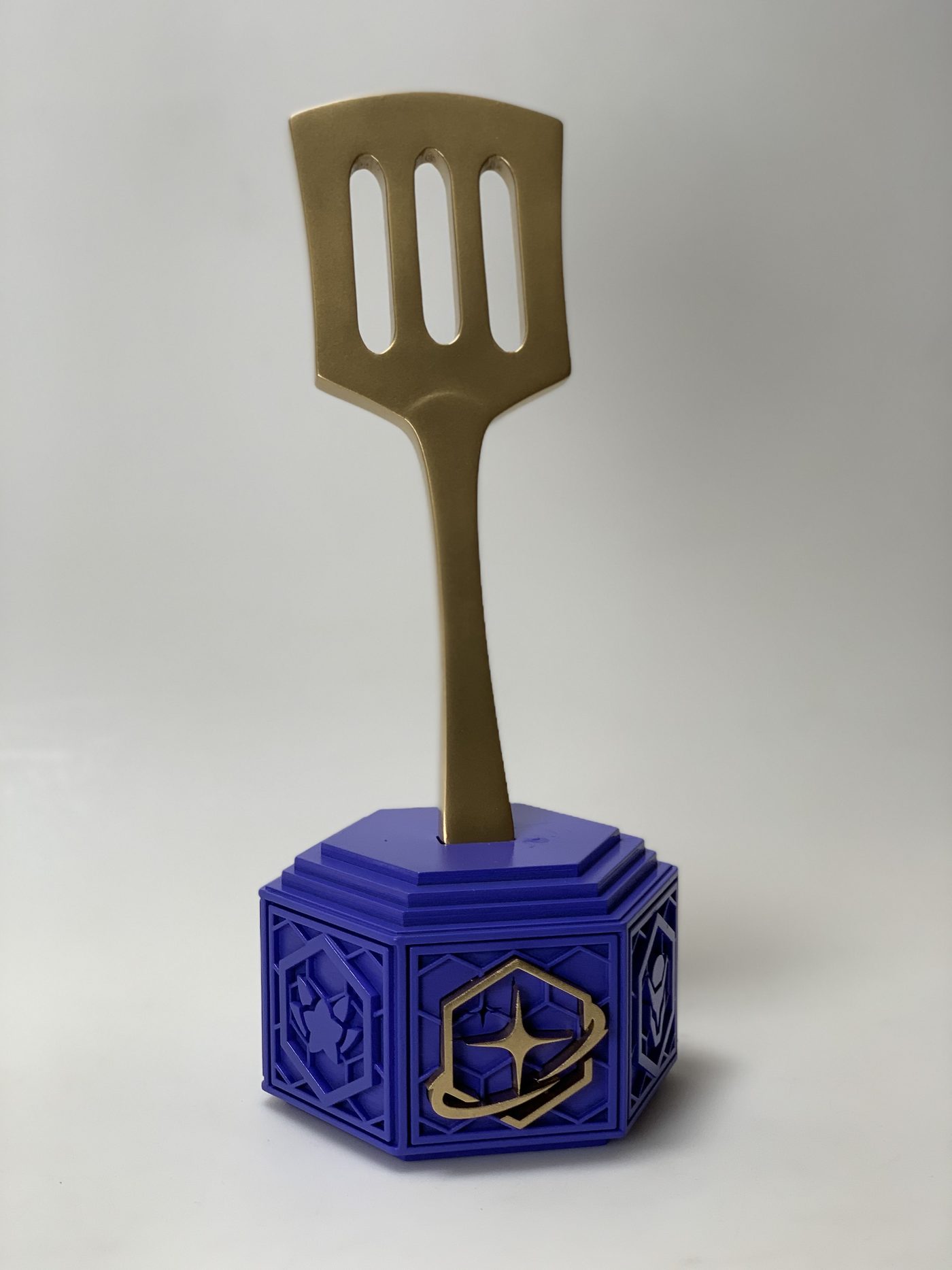
Yes. We can replicate or extend an existing trophy series from samples, photos or old files. If you have a physical trophy, a set of good photographs or the original files, send whatever you have. Painted elements can be matched to the original color, and we retain Pantone mix formulas for repeat orders on our own work. Ask early about matching a series made somewhere else, since older pieces usually have to be measured and modeled; our 3D scanning service can capture an existing piece for reference.
How do you build a timeline backward from the ceremony?
Work from the event date. The stages below use our published ranges; plan your own buffer on top.
- Ceremony or delivery date. Fixed.
- Ship or deliver 1 week before at the latest. Leave time to check the pieces and fix any problems; this buffer is our advice, not a fixed rule.
- Production and finishing. 3–6 weeks depending on quantity and finish, with plating adding about two weeks.
- First-article approval. A 2–4 week stage that has to finish before production begins.
- Design and renderings. Renderings and finish samples typically arrive within 3–5 business days once the brief is settled.
- Kickoff and quote. We typically respond within 24–48 business hours.
Adding those up, a complex, plated program can take a couple of months from kickoff, so begin as soon as the concept is agreed. If the date is closer than that, tell us. Rush production is available, though it will affect what is possible, and we manage NDAs as standard if the design is confidential until the ceremony.
What are the common planning mistakes?
- Choosing the finish last. Plating adds two weeks and changes the surface preparation, so it belongs in the first conversation.
- Waiting on names. If final winners are unknown until late, split the sculpture from the nameplate and schedule the plates for the end.
- Skipping the first article. Approving from renderings alone means the first time you hold the trophy is when the whole run exists.
- Forgetting delivery details. Multi-address shipping needs a clean list, and a venue delivery needs a contact who can receive it.
- Underestimating approval time. Each round of feedback moves every date after it.
Planning rule
Fix the ceremony date, then subtract delivery buffer, production, first-article approval and design in that order. If the total is longer than the time you have, tell us at kickoff so we can talk about rush options.
What does a kickoff request look like?
Send: the concept or reference images, the event date and quantity, your preferred finish, personalization requirements, delivery locations and the name of the person who approves. That is enough for us to quote. You can also read how a good request is put together in our guide on what to include in a custom fabrication quote request, or take a look at more finished pieces on our work page.
Tell us your event date, quantity and finish, and we will map the trophy timeline backward from your ceremony.
Request a QuoteFrequently Asked Questions
How long do custom trophies take to make?
A prototype or first article takes 2–4 weeks, and standard production takes 3–6 weeks depending on quantity and finish. Gold or chrome electroplating adds about two weeks. Total time depends on design approval speed, so start as soon as your concept is set and tell us your ceremony date up front.
Can you personalize each trophy with a different name?
Yes. We can add engraving, nameplates, serial numbers and individual names to a shared sculpture. Send the recipient list as a clean spreadsheet with exact spellings, titles and category text, and have someone proofread it on your side before production. We engrave what you send, so a corrected list before production is far easier than a corrected trophy after it.
What is the minimum order for custom trophies?
There is no minimum quantity, and one trophy is a fine order. We focus on commercial and production projects. For runs over 100 units, we provide mid-production samples so you can approve progress before the batch is completed.
Can you match or continue a trophy from a previous year?
Yes. We can replicate or extend an existing trophy series from samples, photos or old files. Send whatever you have of the original. For our own past work, we retain Pantone mix formulas so painted elements can match on repeat orders.
Do you ship trophies to individual recipients?
Yes. We can ship to many recipient addresses as well as to a single venue, and we offer custom packaging and presentation cases. We are based in Los Angeles with local pickup or same-day local delivery, and ship nationwide and internationally.
Which trophy finish is best for a televised awards show?
Plated finishes such as gold or chrome electroplating read as real metal on camera, and metallic spray paint does not hold up the same way under production lighting. Plating adds about two weeks. Painted and Pantone-matched finishes are better when a specific brand color matters more than a metal look.
Have a project in mind?
Hollywood 3D Printing designs, fabricates, and finishes custom pieces for brands, agencies, productions, and events, all under one roof in Los Angeles. Tell us what you’re building and when you need it.
Start Your Project TodayPrefer to talk it through? Call (323) 645-7640.
Related Reading