hold.that.thought. Blog
3D Printing vs. CNC Foam Milling vs. Hand Sculpting
By Hollywood 3D Printing ·
Key Takeaways
- Under about 12 x 12 x 12 inches, 3D printing is usually stronger and sharper than foam; above that, foam is the practical way to get size.
- 5-axis CNC milling in EPS foam is light and simple with low detail, while HDU urethane foam (4-lb or 6-lb) is stronger and holds sharper detail.
- Hand-sculpted foam from reference images is less precise than milling and fits displays and landscapes, while milling suits pieces that must match a file.
- Foam pieces get a polyurea epoxy hard coat about 1/16 inch thick, sanded smooth before paint, and large pieces are built in doweled sections.
- Hybrid builds pair a foam body with SLA-printed hero details to keep weight down and put detail where it matters.
For a large prop or sculpture, use 3D printing when the piece is small or highly detailed, CNC foam milling when it is big and needs accurate, repeatable geometry, and hand-sculpted foam when the piece is a loose, artistic form such as scenery or a landscape. As a rule of thumb, anything under about 12" x 12" x 12" is usually stronger and sharper printed than carved from foam. Above that size foam takes over, and the real decision is between a machine-cut body from a digital file and a sculptor working from reference images.
We run all three under one roof in Los Angeles, so this is the comparison we walk clients through when a piece is somewhere between “fits on a desk” and “fills a booth.” It also covers how foam pieces get their hard shell, how huge pieces are assembled, and when a hybrid build makes the most sense.
How do 3D printing, foam milling and hand sculpting compare?
| Method | Best for | Detail level | Typical size | Finish path | Where it falls short |
|---|---|---|---|---|---|
| SLA resin printing | Small to mid-size hero pieces, fine detail, mold masters, plating | Highest; smooth surface | Small to mid-size, or printed in sections | Sand, prime, paint or plate | Solid volume gets heavy and slow to print as size grows |
| FDM printing | Large structural volumes and general-purpose parts | Moderate; visible layer lines | Large, built in sections | Sand, prime, paint | Layer lines take real finishing work |
| 5-axis CNC milling in EPS foam | Big, simple shapes where fine detail is not critical | Low | Large; sectioned for the biggest pieces | Epoxy hard coat, sand, paint | Soft material, low detail |
| 5-axis CNC milling in HDU foam | Big pieces that need sharper detail and a sturdier body | Sharper than EPS | Large; sectioned for the biggest pieces | Epoxy hard coat, sand, paint | Needs a digital model first |
| Hand-sculpted foam | Displays, landscapes and loose forms built from reference images | Depends on the sculptor; less precise | Large | Epoxy hard coat, sand, paint | Not an exact match to a file or an existing object |
These ratings follow how we work: SLA gives the sharpest, smoothest surface, while FDM leaves visible layer lines and suits large structural volumes. Our 3D printing service covers both, and our foam milling service covers the milled and hand-sculpted work.
When is 3D printing the better choice for a big piece?
Printing wins whenever detail, strength or a route to plating matter more than raw size. Under roughly 12" x 12" x 12", a printed part is usually both stronger and crisper than a foam one, because foam is a soft material and small features cut into it are fragile.
SLA resin is our choice for hand-painted display pieces, mold masters and anything that will be chrome or gold plated, since plating requires SLA resin sanded to 1000-grit. FDM covers the big structural volumes. Very large printed pieces are built in sections and joined, which we cover in our guide to large-scale 3D printing.
The tradeoff is that printed volume becomes impractical as a piece grows. A solid printed body the size of a person takes far more material and machine time than a milled foam body of the same size, and that gap is the reason foam is part of our shop at all.
What is CNC foam milling, and how do EPS and HDU differ?
CNC foam milling means a 5-axis machine cuts your digital model out of a block of foam. Because the tool can approach the block from several angles, it reaches curves and undercuts that a simpler router would miss. The result follows the file closely, and a second copy cut from the same file matches the first.
EPS (styrofoam)
EPS is the lightweight, simple option. It is light and easy to mill, but the surface is coarse and it does not hold fine detail. It suits large, simple massing: a big shape that will be coated, sanded and painted, where nobody needs to see crisp edges or small features.
HDU (urethane foam), 4-lb and 6-lb
HDU is a denser urethane foam, available in 4-lb and 6-lb densities. It is stronger than EPS and takes sharper detail, so it is the better material for lettering, ornament, facial features and anything that must hold a crisp edge.
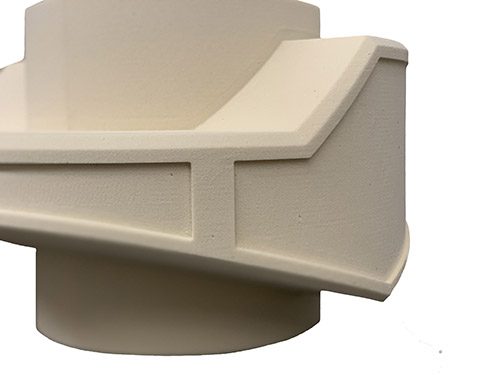
Single-part foam orders are typically ready 2 to 4 days after production begins. Larger pieces and quantity orders take longer, and every quote includes lead time.
CNC milling or hand sculpting: which one do you need?
Choose milling when the piece has to match something exact: an existing object, a logo, or a design already approved in renderings. Choose hand sculpting when the piece is an interpretation, such as terrain, a rock formation or set dressing, and a sculptor working from reference images can get there faster than a modeler can build a file.
- Precision. Milling follows the file. Hand sculpting follows the sculptor’s eye, so it is less precise and the result reflects the artist’s interpretation of the references.
- Repeatability. A milled piece can be cut again from the same file. A hand-sculpted piece is a one-off unless it is later scanned or molded.
- Upfront work. Milling needs a digital model. If you do not have one, we build it through our 3D design service from sketches, dimensions and reference images, which adds a design step before cutting starts.
- Where each fits. Hand-sculpted foam works well for displays and landscapes. Milled foam suits pieces where proportions, symmetry and detail must be exact.
If a hand-sculpted piece needs to be duplicated later, it can be scanned and reproduced. We cover that route in our post on copying sculptures with 3D scanning and silicone molds.
How do you finish a foam sculpture so it holds up as a prop?
Bare foam is not a finished surface. It dents, takes paint unevenly and shows every tool mark, so foam pieces get a hard coat first. We apply a polyurea epoxy hard coat about 1/16" thick. It dries with an orange-peel texture, so the coat is sanded smooth before any paint goes on.
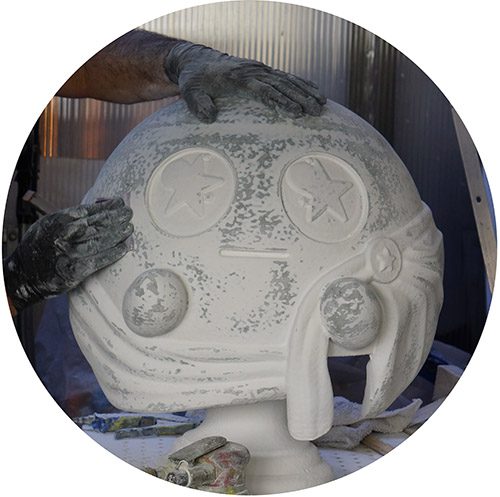
From there the piece goes through the same finishing line as everything else in the shop: sanding, priming, then spray booth, airbrush or hand painting. That includes marble, stone and wood-grain mimicry, Pantone-matched color and a durable clear coat. Our painting and finishing service handles it in one place, and our guide to painting and Pantone matching goes deeper on color.
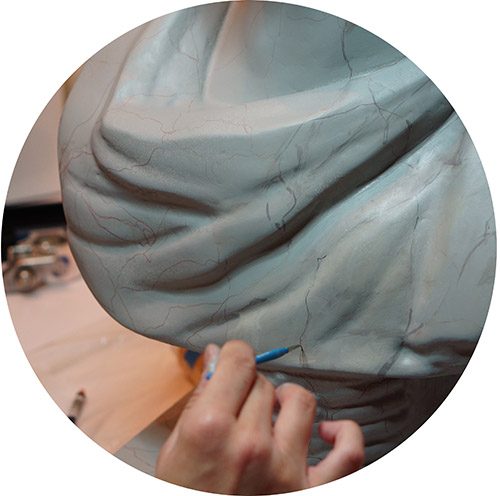
Foam is painted, not plated
Chrome and gold electroplating needs SLA resin sanded to 1000-grit, so a foam body takes paint finishes, including metallic paint, rather than plating. If real plated metal matters, that part should be printed.
How are very large pieces built and shipped?
Big pieces are built in sections. Each section is milled, sculpted or printed separately, then doweled and assembled, and we can ship the sections separately for assembly on site. Our maximum fabrication scale is 15+ feet, with assembled pieces up to roughly 10 to 15 feet.
Sectioning shapes the design, so plan it early. Where the seams fall decides how invisible they are after finishing, and joints along natural breaks like a collar, belt line or panel edge are easier to disguise than a seam through a face.
Weight and shipping generally favor foam, since a foam body is light for its size and easier to hang or move than a solid printed one. How a piece travels is its own design question, and we cover it in engineering oversized pieces to ship and assemble. For booth timelines, see our trade show display work.
When should you combine methods?
Hybrid builds are common and often the smartest answer. The pattern is simple: mill the body in foam for size and economy, and print the parts that need fine detail in SLA resin. A large character, for example, can have a foam torso and limbs and a printed face, hands or logo plate that carries the crisp features foam cannot hold.
- Foam body plus printed hero detail: keeps the piece light and quick to build where nobody looks closely and puts the fine detail where they do.
- Foam terrain or base plus printed structures: common for scale models and dioramas.
- Printed master plus molds: when you need several copies of a small detail, a silicone mold is often the next step (see silicone mold casting vs. 3D printing).
The same thinking applies to custom props and oversized brand pieces: match each part of the object to the method that suits it, rather than forcing one method onto the whole thing.
What should you send to get a quote?
Send the overall size, the number of pieces, where it will be displayed, and any reference images, sketches or files (STL, OBJ, STEP or IGES). Tell us the finish you want and your event or shoot date. If you are not sure which method suits the piece, that is our job: we will recommend one and quote it with lead time included. Start with our quote form.
Tell us the size, the finish and the deadline, and we will recommend the right method and quote it.
Request a QuoteFrequently Asked Questions
Should I use CNC foam milling or 3D printing for a large piece?
For large pieces, foam milling is usually the better fit, because foam is far lighter and faster to produce per volume than printed resin. For small pieces the opposite holds: under about 12 by 12 by 12 inches, 3D printing is usually stronger and holds finer detail. The right method depends on size, foam type and finish, so we quote each project individually.
What is the difference between EPS and HDU foam?
EPS is styrofoam: light, simple and low in detail. HDU is a denser urethane foam, available in 4-lb and 6-lb densities, that is stronger and holds sharper detail. We mill both on a 5-axis CNC machine, and the right choice depends on how much fine detail the piece needs.
How do you finish foam sculptures for painting?
We coat the foam with a polyurea epoxy hard coat about 1/16 inch thick. It dries with an orange-peel texture, so it is sanded smooth before priming and painting. The result is a durable surface that takes spray, airbrush or hand-painted finishes, including Pantone-matched color.
How big can a foam prop or sculpture be?
Our maximum fabrication scale is 15+ feet, with assembled pieces up to roughly 10 to 15 feet. Very large pieces are built in sections, doweled and assembled, or shipped in pieces for assembly on site. Sectioning is planned into the design from the start.
Can you make a hand-sculpted foam prop from photos?
Yes. Hand-sculpted foam can be made from reference images and suits displays and landscapes. It is less precise than CNC milling and reflects the sculptor’s interpretation. If you need an exact match to a design, milling from a digital model is the better route.
Can foam pieces be chrome or gold plated?
No. Our electroplating is done on SLA resin parts sanded to 1000-grit. Foam pieces are hard coated and painted, and metallic paint finishes are available for them. If you need real plated metal, that part should be printed in SLA resin.
Have a project in mind?
Hollywood 3D Printing designs, fabricates, and finishes custom pieces for brands, agencies, productions, and events, all under one roof in Los Angeles. Tell us what you’re building and when you need it.
Start Your Project TodayPrefer to talk it through? Call (323) 645-7640.
Related Reading